

When talking about landscaping and gardens, it helps to view the overall design as two parts that make up a whole composition. First, we can look at the ways landscape designers use artful groupings of trees, shrubs, flowering plants and grasses to create living compositions. The greenscape is the dynamic part of the composition because it is ever growing and ever-changing.
The other part of the composition, the hardscape, is defined by landscaping with stone. It anchors the living part of the composition. The interaction between the inanimate/static (stone) and the living/dynamic (plants) makes a landscape design lively and exciting.
Three Techniques for Landscaping with Stone
Landscaping with stone creates a framework for movement, visual definition and establishes different use areas in the landscape. Patios, walls, steps and walkways help us navigate changing elevations on site and define a variety of “places.”
Stone and boulders are used in landscaping as:
- a structural element to support terraced slopes, frame raised planting beds or building specialty structures.
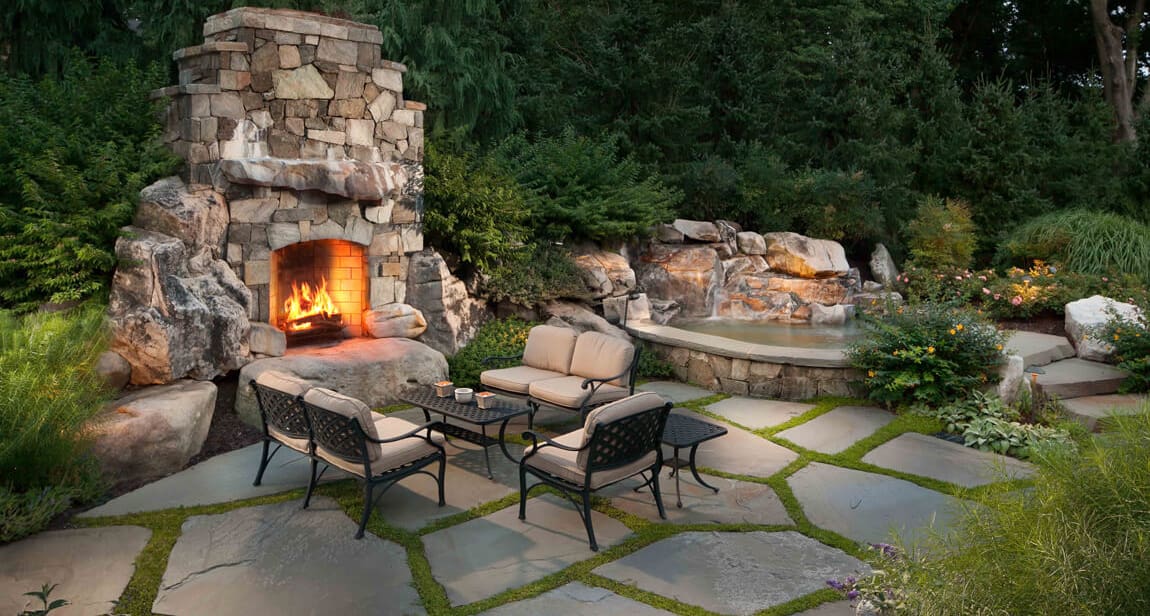
Example: garden retaining walls or outdoor fireplaces - a formal element to define different outdoor spaces and the connections between them.
Example: patio and pool decks, retaining walls (also used as a structural element), stepping stone paths and walkways - a compositional or decorative element in and among plants or as a stand-alone hardscaping feature. Example: garden waterfalls
Landscaping with stone, the interaction it generates between the static (stone) and the dynamic (plants), makes a landscape design livley and exciting.
The most familiar uses of stone in landscaping are for constructing the structural and formal hardscape features. Landscaping with stone as a compositional element can add tremendously to the aesthetic effect of a well-planned garden.
Using Fieldstone & Boulders as a Compositional Element in Landscaping

Weaving natural stone and boulders into the planted portion of a landscape brings balance, depth and added visual interest to the design as a whole.
Landscape architect Howard Cohen says he always looks for opportunities to use stone and boulders as compositional elements to “break up” the softness of planted material with artfully placed fieldstone boulders. Artfully placed stone can insert moments of strength and weight into a swath of tall grasses, for example.
When done well, the combination of hard/inert and soft/living elements lends a more organic or “found” look to the landscape—particularly in an informal, naturalistic style landscape built with grasses and perennials. The idea is to achieve a holistic landscape, one that acknowledges the style of the house architecture as well as the physical attributes present on the site.
Cohen attempts to replicate what you might find in nature by the way he distributes fieldstones around the property: some groupings, some loners, different sizes and shapes, some mossy and some bare. The arrangement and distribution of stones on the site are important because they will feature more prominently in winter. They must be able to stand on their own as a design feature.
The combination of hard (stone) and soft (plants) elements lends a more organic or “found” look to the landscape
Cohen says that it’s essential when landscaping with stone to fully understand the growth patterns of the selected plants because in just a few years boulders may “disappear into the greenery” as plants mature to full size: “You have to anticipate how the landscape is going to fill in as you plan and layer your plantings—how tall they will grow and how wide they will bush out. You are trying to create an effect that includes stone and boulders with plants growing in and around them. And the stones have to be sized appropriately”.
The size of the area being planted and that of the site overall will dictate the right-sized boulders for the landscape.
Types of Stone Used in Landscaping
The stone used in landscaping is usually taken from a nearby regional source.
We classify the stone we use in landscaping by the way it is naturally shaped and by how we use it in the landscape:
Flagstone
Flagstone is quarried from layers of sedimentary rock. A fundamental characteristic of flagstone is that it can be split into relatively flat layers of varying thickness. It is ideal for patios, pool decks, wall caps, and garden walkways.
Fieldstone (Boulders)
Unlike flagstone, fieldstone is not quarried. It is found near the Earth’s surface in rock outcrops or in areas that contain ancient glacial deposits. This rough surfaced, weathered stone comes in irregular shapes, and with rounded edges. A key feature of fieldstone is its craggy edges, scars, and numerous crevices that naturally support the growth of beautiful moss or lace lichen. Fieldstone works very well when used in fireplaces, waterfalls and around ponds.
Stone Slabs
Slabs are usually cut 3″ to 5″ thick and are used for stairway steps, steppingstone walkways, and waterfalls
Building Stone
Can be any type of stone. Pieces are roughly shaped at the quarry so they can be fine-tuned on site by craftsmen. They are used in building retaining walls or fireplaces.
Stones are selected for a certain level of imperfection and inconsistency to achieve a somewhat “disheveled” look that is in fact painstakingly curated.
Balancing Hardscape and Greenscape
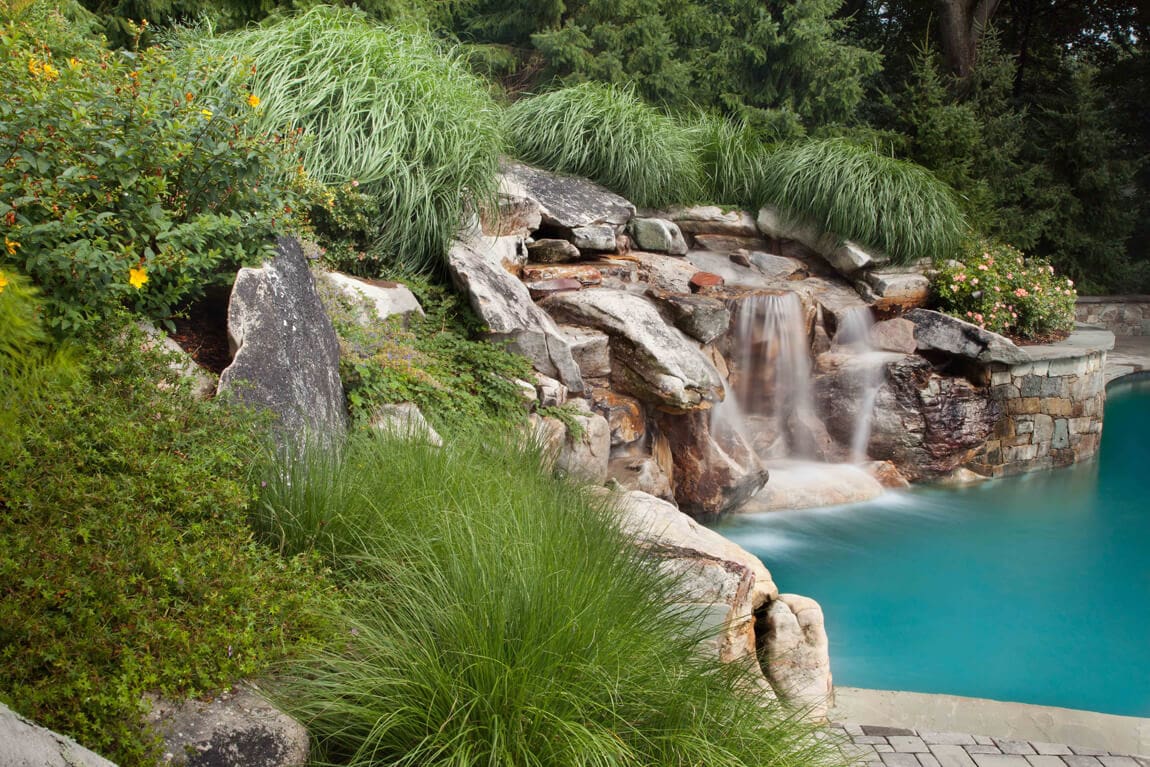
Cohen says that when a shipment of fieldstone arrives for a project, he examines the rock: “you try to imagine how it was already sitting in nature–or how it wants to sit. Then you try to use it similarly”. He selects for a certain level of imperfection and inconsistency to achieve a somewhat “disheveled” look that is in fact painstakingly curated.
He also takes care to position the boulder on solid ground so it won’t shift or sink in time. Some minor excavation is required to seat the stone, but only a little because the plants will grow up around it. And if it gets overgrown, you will lose the effect.
There other ways of landscaping with stone such as xeriscaping, Zen garden design, and mulching with stone. These techniques work well in regions where precipitation is sparse and the heat index is higher. We don’t do much of it in our region because rain and humidity are plentiful and vegetation is lush. Customers rarely ask for it.
Achieving balance among compositional and formal use of stone and plant varieties in a landscape is driven by the client’s preferences and budget. Stone adds a lot to a landscape design. But it is expensive and is often the first thing to be cut when the budget is pushing the limit. We do our best to blend the best of both parts of the design in all of our landscaping projects.
If you’d like to explore the potential for adding a greater level of detail and depth to your landscape, schedule a consultation with one of our landscape architects.